Liquid Tongues
Bogna Burska, Daniel Kotowski
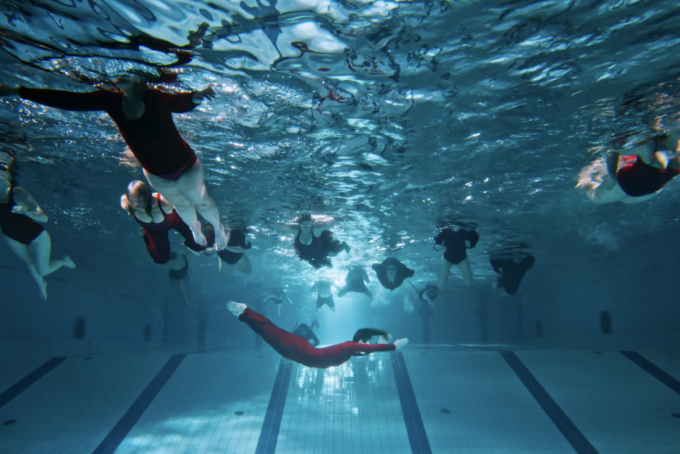
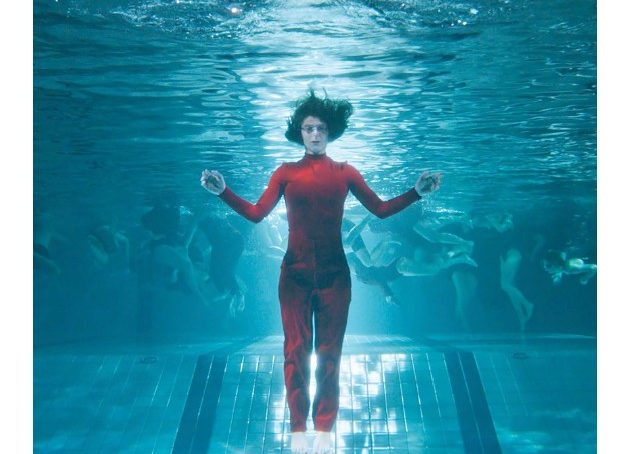
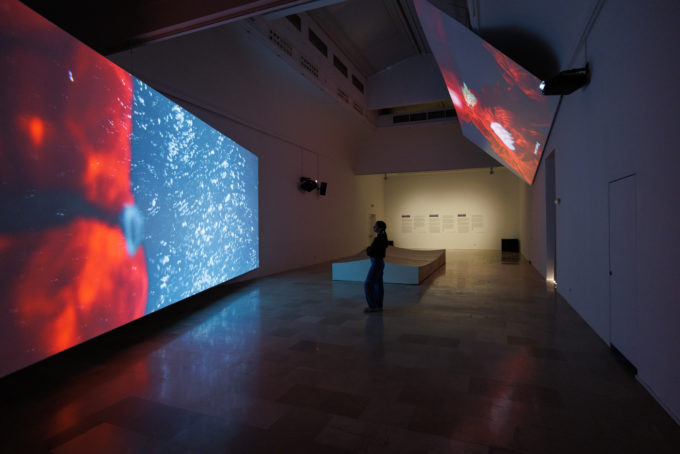
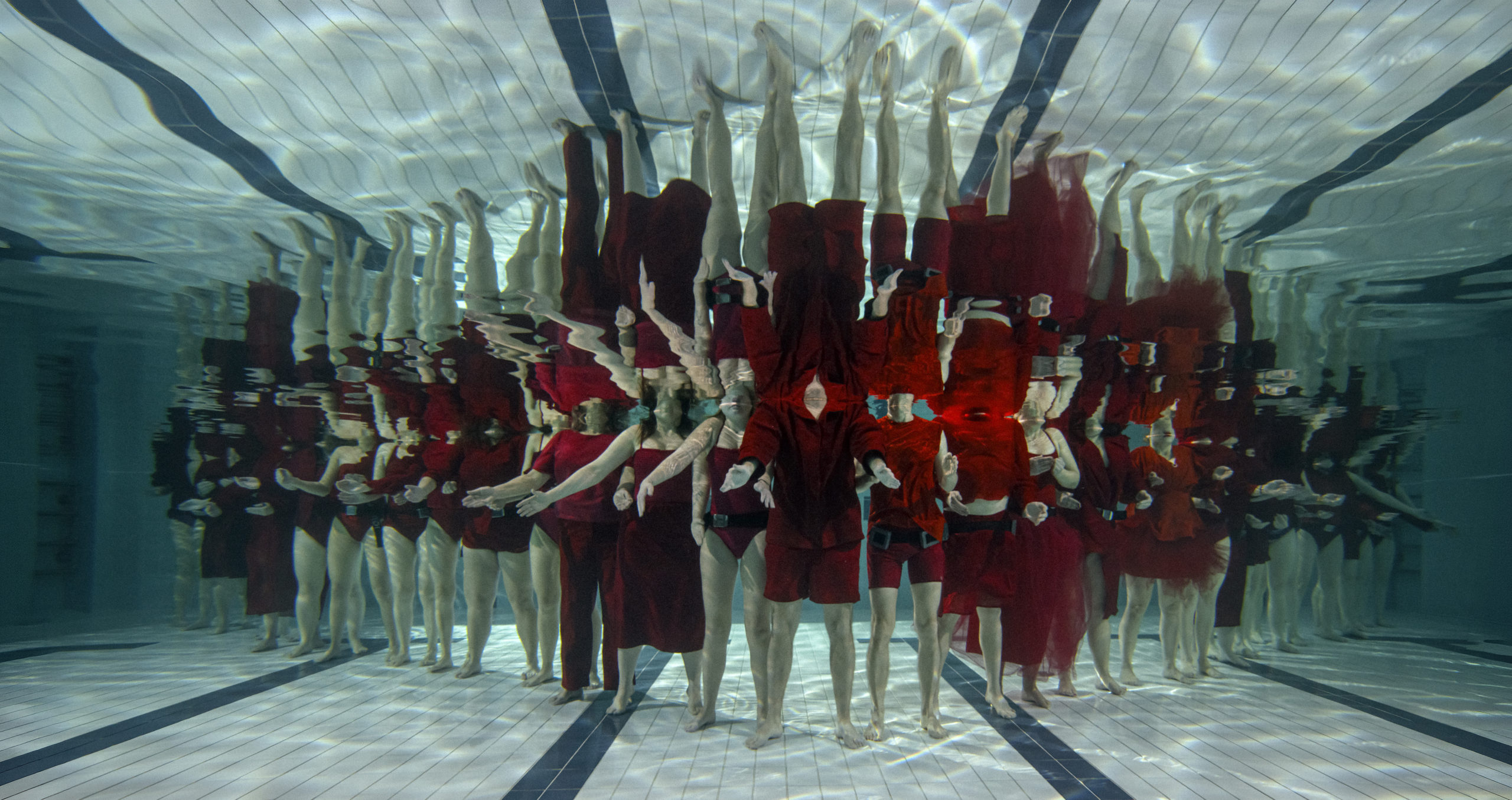
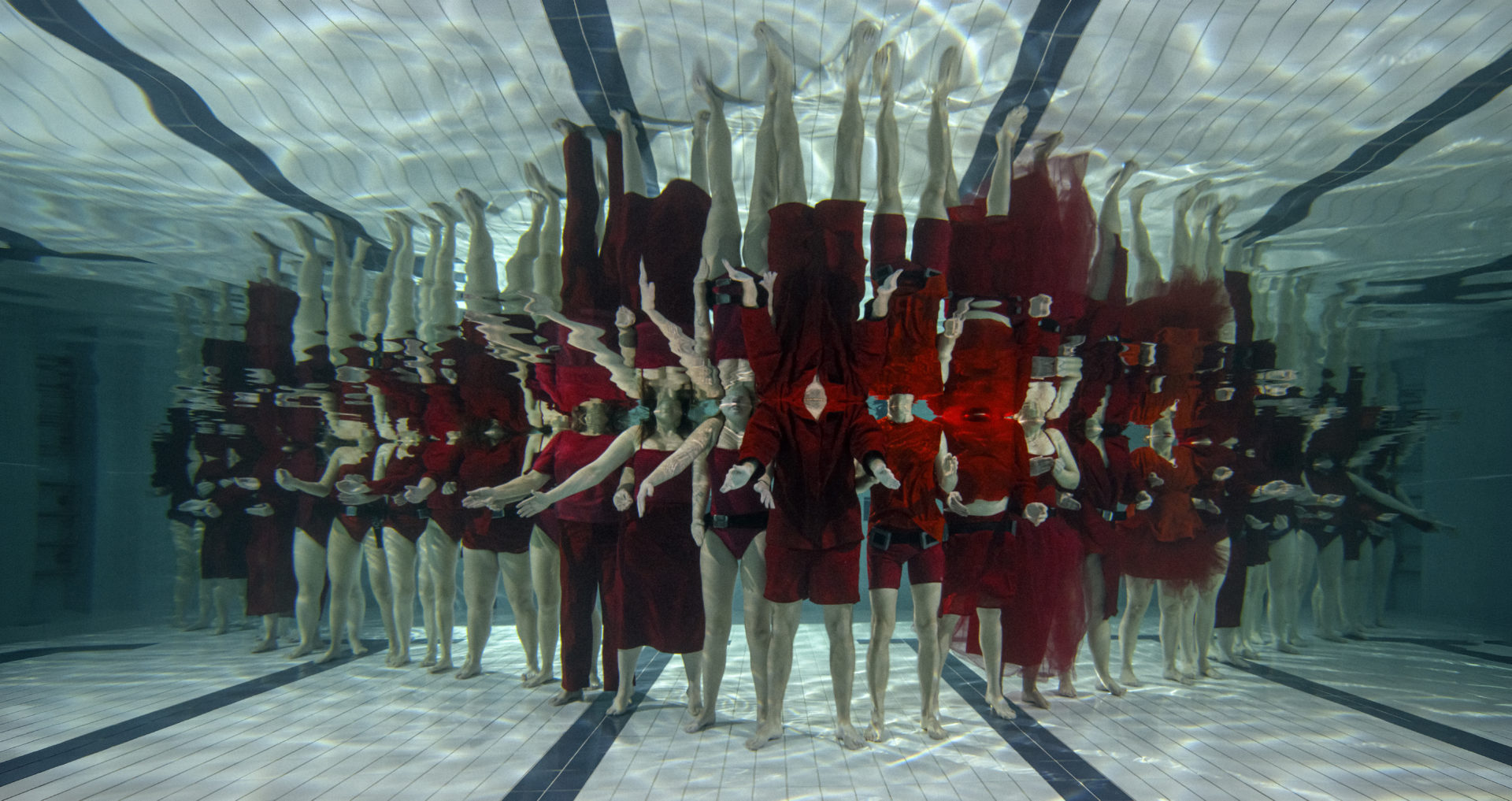
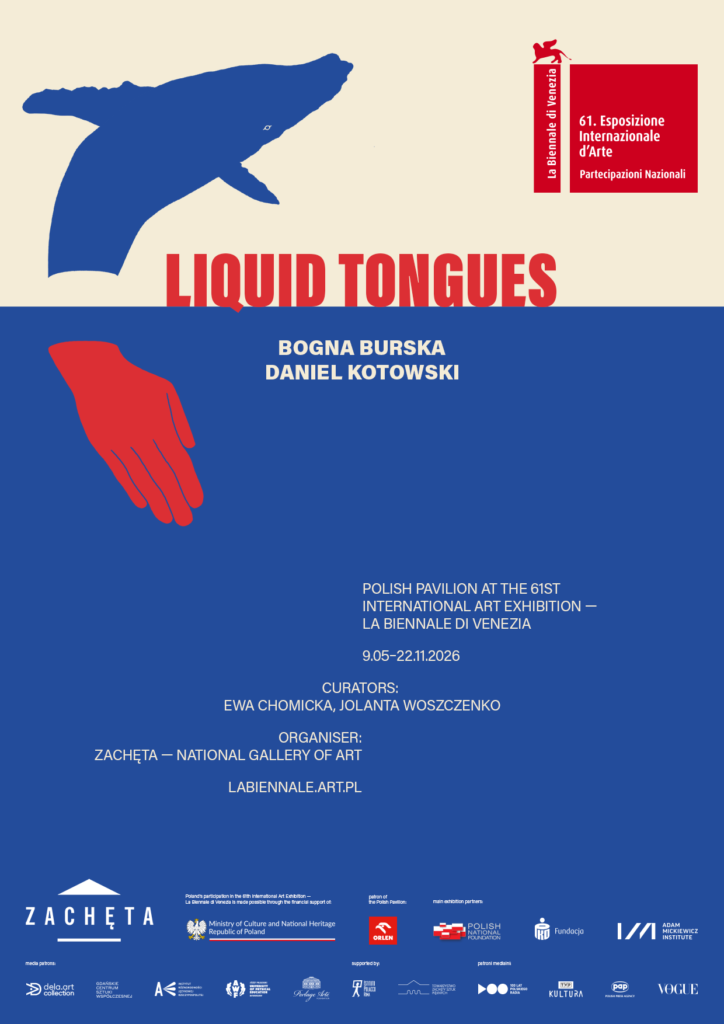
Liquid Tongues is an audio-video installation in which Bogna Burska and Daniel Kotowski seek alternative ways of communicating inspired by more-than-human life. The social Choir in Motion (Chór w Ruchu), made up of hearing and Deaf people, perform interpretations of the communication codes and songs of whales, simultaneously in English phonic and international sign (IS) languages, building visual-spatial-sonic fantasias on the theme of possible translations. The installation operates on multiple levels: image (cinematography by Magda Mosiewicz), movement (choreography by Alicja Czyczel), sound (music composed by Aleksandra Gryka), and the physical experience of acoustic waves.
The project was inspired by Roger Payne’s legendary recordings, Songs of the Humpback Whale (1970), which led to a ban on whale hunting and saved them from extinction. The complex sounds of these songs reminded the world of the intelligence and richness of animal culture, showing art could save voices that were once inaudible.
Liquid Tongues is a tale of loss, but also of the reconstruction of cultures and modern-day work to retrieve languages marginalised by the dominant narratives. It is a story of Payne’s work and the significance of his recordings. It recounts new and unknown (or perhaps old and reborn) collections of hundreds of generally solitary humpbacks on the west coast of Africa. It involves works created on the qilaat – a ritual drum used by the natives of Greenland, although no one knows how it sounded prior to the island’s brutal colonisation. As well as work on restoring Hand Talk – Plains Indian Sign Language – the universal sign language of hearing and Deaf native inhabitants of the Great Plains of North America. It is a tale about breaking with the oppression of phonetic training and building Deaf subjecthood. It is the recurring feminist figure of the whalerider, inspired by the New Zealand myth. The stories evoked here allow us to imagine, in spite of everything, alternatives for the world – opportunities to rebuild what has collapsed or been destroyed by the dominant voices. We might join Sabrina Imbler in asking: ‘How shall you regrow, and in how many ways?’
According to the idea of Deaf Gain, deafness is understood not as a disability, but as a separate culture and identity offering new perspectives and forms of expression. Much of the material has been gathered in the water, an environment where Deaf people can communicate freely in sign language, while hearing people can only produce warped sounds. The line between air and water is a space for communication experiments, a mirror of sorts where various languages, bodies and sensibilities meet.
In the curatorial concept for Biennale 2026, based on the musical metaphor of a ‘minor key’, Koyo Kouoh extends an invitation to contemplatively encounter what is delicate and generally overlooked – softer voices, neglected narratives, micro-memories. She encourages us to develop subtle forms of resistance, sensitive experiments, to build polyphonic scores of mutually resonating societies. The Liquid Tongues installation explores this idea, attempting to break through what we imagine to be the limits of communication and to create subjective communities, taking various perspectives into account. In a projected version of the future – including animal perspectives.
- YEAR2026
- CATEGORY Biennale Arte
- EDITION61.
- DATES9.05-22.11.2026
- COMMISSIONER Agnieszka Pindera
- CURATORS Ewa Chomicka, Jolanta Woszczenko
-
Poland’s participation in the 61th International Art Exhibition — La Biennale di Venezia is made possible through the financial support of the Ministry of Culture and National Heritage of the Republic of Poland.
organiser: Zachęta — National Gallery of Art
patron of the Polish Pavilion: ORLEN
main partners of the exhibition: Polish National Foundation, PKO Bank Polski Foundation, Adam Mickiewicz Institute
exhibition partners: dela. art collection, Gdańskie Centrum Sztuki Współczesnej, Institute for Linguistic Diversity of the Republic of Poland, Józef Piłsudski University of Physical Education, Perlage Arte Foundation
supported by: Polish Institute in Rome, Society for the Encouragement of Fine Arts
media patrons: Polish Radio, TVP Kultura, Polish Press Agency, Vogue Polska
special thanks to: Aktywna Warszawa, Common Arts Foundation, Państwowe Gospodarstwo Wodne Wody Polskie

-
Authors
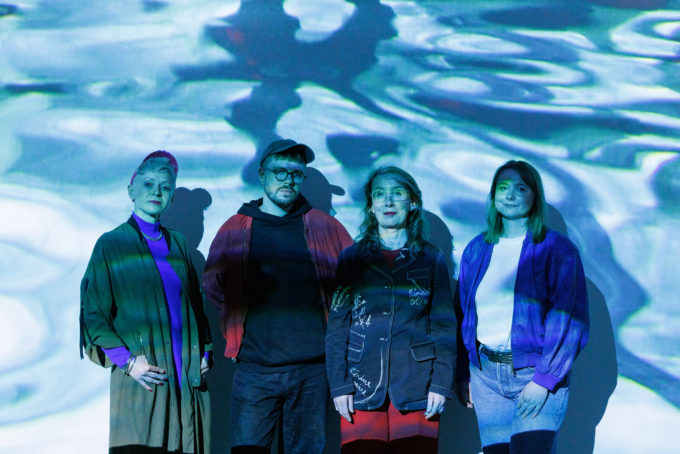
Bogna Burska – a co-author of the work Liquid Tongues. She is a visual artist using many forms of expression and a writer of dramas, presently a professor at the Academy of Fine Arts in Warsaw. Her works address themes of physicality, memory and emotion, often drawing from social narratives and visual pop-culture cliches. She juxtaposes what is beautiful with what is widely considered to be ugly, revolting or rejected. As of late, she has mainly been working with themes of communication and structures of mutual understanding in changing ecosystems. She has taken part in many exhibitions in Poland and abroad; her work combines an artistic perspective with research and teaching.
Daniel Kotowski – a co-author of the work Liquid Tongues. An artist and a performer. His practice focuses on the experiences of the Deaf, issues of language, communication, biopower and biopolitics. His work explores the limits of physicality and means of expression that go beyond the dominant speech structure. He has appeared and presented his work in the Museum of Modern Art in Warsaw, Zachęta – National Gallery of Art, Studio Theatre, and Pickle Bar in Berlin.
Ewa Chomicka – a co-curator of the exhibition Liquid Tongues, curator of the Choir in Motion. She is a cultural anthropologist, curator of contemporary art, and facilitator. She runs the Museum Practices Lab at the POLIN Museum of the History of Polish Jews. She develops interdisciplinary projects, joining contemporary art, research and activism, often of a performative, interventional or social nature. Engaged in environmental initiatives, co-founder of the Culture for Climate collective.
Jolanta Woszczenko – a co-curator of the exhibition Liquid Tongues. A curator of contemporary art, tied to the Gdańsk Centre for Contemporary Art since 2008. She is interested in experimental forms of film and video, and in communication processes – both between artist and viewer and between various media and disciplines in art.

photo by Filip Preis/Zachęta Archive
Accessibility of the exhibition
The film screening lasts 30 minutes, beginning on every half hour, but you may enter at any time.
The film has enhanced subtitles, including the descriptions of the sounds.
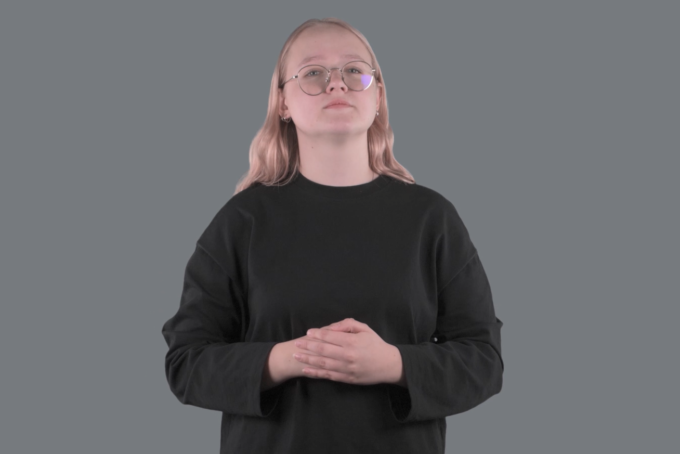
The curatorial texts in international (IS), Italian (LIS), and Polish sign language (PJM) are available through the QR codes situated directly below them.
Textual audiodescription of the exhibition in English is available through a QR code situated at the entrance of the exhibition.
Materials regarding the accesibility of the exhibition are published online on the Polish Pavilion website through ‘media’ page.
The brochure accompanying the exhibition written in Plain English language is available at the entrance of the Pavilion.
Architectural accesibility of the building
The Polish Pavilion building has a ramp with handrails leading to a terrace-like area.
There is a low step just before the entrance from the terrace into the building.
The exhibition space is accessible to people in wheelchairs.